
The Big Freeze: Why Greenland and Trade Wars Are Cracking the Western Alliance
For decades, the “Transatlantic Partnership” between the United States and Europe was the bedrock of global stability, a post-World War II order built on mutual defense and shared economic values. However, recent geopolitical shifts suggest this foundation is fracturing.
From the icy strategic depths of Greenland to the heated tariff battles in Brussels, a new narrative is emerging: The United States is prioritizing “America First” in ways that threaten the economic sovereignty of its oldest allies.
This post explores why a frozen island has become the center of a global power struggle and how the US-Europe dynamic is shifting from cooperation to coercion.

1. The Greenland Prize: Why the US Wants It
To the average observer, Greenland looks like a “useless block of ice.” Yet, to US strategists, it is a $4.4 trillion “geological treasure chest” and a military necessity. The interest in acquiring Greenland, particularly under Donald Trump’s philosophy, boils down to three distinct pillars:
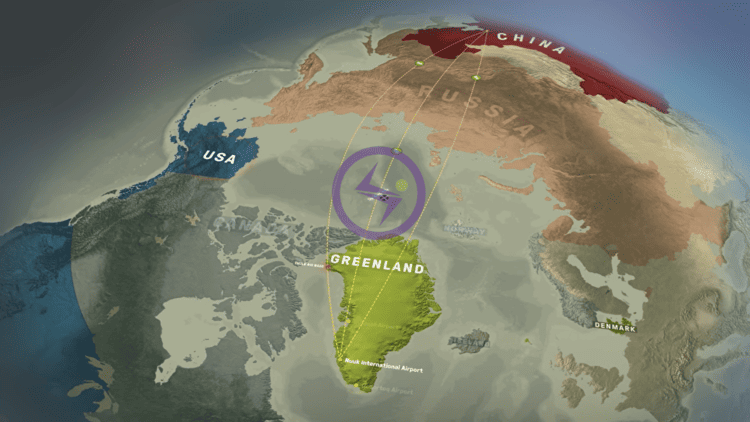
- Military Dominance (The Front Door): Greenland is the exact geographic midpoint between the US and Russia. Controlling it secures the “front door of the western world.” Crucially, radars in Greenland provide a nuclear early warning system, granting the US 15 to 20 minutes of extra intercept time the difference between survival and destruction for cities like New York.
- The Rare Earth Monopoly: The island is an “energy jackpot” holding 31 billion barrels of oil and vast natural gas reserves. More importantly, it holds a “rare earth monopoly” containing materials critical for F-35 fighter jets, electric vehicles, and wind turbines.
- The New Global Trade Route: Climate change is melting the ice, opening the Northwest Passage. This route cuts the distance between London and Tokyo by 7,000 km compared to the Panama Canal, saving shipping companies millions in fuel and wages. Whoever owns Greenland owns the “toll booth” to this future trade super-highway.

2. The Acquisition Strategy: Buyout or Hostile Takeover?
The US strategy involves leveraging Greenland’s economic dependence on Denmark. Currently, Denmark subsidizes Greenland with roughly $600 million annually.
- The “Soft” Approach: The US could offer to replace this subsidy with $1 billion a year plus direct investments, encouraging Greenland to declare independence from Denmark and sign a defense treaty with Washington.
- The “Hard” Approach: Tensions have risen to the point where the rhetoric suggests that if a deal isn’t made “the easy way,” it might be done “the hard way”. This creates a geopolitical nightmare: Greenland is a territory of Denmark, a NATO member. Technically, under NATO Article 5, an aggressive US move on Greenland could legally force allies like France, the UK, and Germany to go to war against the United States to defend Denmark.
3. The Transatlantic Fracture: A Coalition of Resistance
The dispute over Greenland is merely a symptom of a wider strain on the Transatlantic Partnership. Europe is no longer passively accepting US dominance.
A coalition of roughly eight nations including France, Germany, the UK, Finland, Sweden, Norway, and the Netherlands has signaled solidarity with Denmark. This represents a significant transformation in the post-WWII order. European nations are now finding themselves in a position where they must balance their national security needs (guaranteed by the US) against economic threats coming from that very same ally.

4. Tariffs, Military Spending, and Economic Sovereignty
Two major friction points are driving this wedge between the US and Europe:
- The 2% Ultimatum: The US has aggressively demanded that NATO members meet the requirement of spending minimum 2% of their GDP on defense. While intended to burden-share, the delivery of this demand has strained diplomatic relations.
- Tariff Warfare: The “Make America Great Again” policy is perceived by some European analysts as a “Make America Weak” strategy because it alienates allies. The imposition of tariffs on European goods challenges Europe’s economic sovereignty. The US is targeting sectors like intellectual property and public procurement, treating European trade surpluses as a threat akin to those from adversaries.
5. Europe Strikes Back: The Anti-Coercion Instrument
Europe is preparing to defend itself economically. The European Union has developed an “Anti-Coercion Instrument”. This mechanism allows the EU to retaliate against economic bullying.
If the US imposes unfair duties (such as a 25% tax or tariff mentioned in discussions regarding trade deals), the EU can now respond with its own countermeasures. This marks a shift where the EU is asserting itself as an independent geopolitical block, unwilling to be a vassal to US economic policy.
6. The China Factor and the “Reverse Kissinger” Failure
A crucial backdrop to this tension is the rise of China, now the world’s second-largest economy.
- The Kissinger Policy: During the Cold War, Henry Kissinger orchestrated a strategy to split China from Russia, aligning the US with a weaker China to contain the Soviet Union.
- The Reverse Kissinger (Failed): In the modern era, a “Reverse Kissinger” strategy would logically involve aligning with Russia (or ensuring strong alliances with Europe) to contain the rising power of China. However, current US policies are simultaneously antagonizing Russia (via Ukraine support) and alienating European allies (via trade wars).
Instead of isolating China, this pressure risks pushing Europe closer to Beijing. As noted in the sources, China is a massive trading partner for Europe. By forcing Europe to choose between US security guarantees and their own economic interests, the US risks fracturing the alliance that has kept the West dominant for 80 years.
Conclusion
The situation regarding Greenland and European trade reveals a paradox. To secure the Arctic and “Make America Great,” the US is pursuing policies that risk dismantling the North Atlantic Treaty Organization (NATO) alliance. As the ice melts in Greenland, the diplomatic freeze between Washington and Brussels is hardening, signaling a volatile new era in global geopolitics.
Watch these videos for further learning :
Critical thinking challenge question :
- Why is Greenland strategically vital for American nuclear defense systems?
- How does the Northwest Passage impact global maritime trade routes?
- What economic resources make Greenland a valuable “geological treasure chest”?
- How does the Northwest Passage reduce global shipping costs?
- Which specific minerals make Greenland a “geological treasure chest”?
- What role does NATO’s Article 5 play in Greenland’s defense?


