Types of non-fiction writing styles

Non-fiction writing is one of the fundamental divisions of prose writing incorporating truthful information of reality regarding an event or people. It can either be an objective or subjective report. Non-fiction writing need not always be a written text. Pictures or films expressing factual accounts of any subject are also referred to as non-fiction writing.
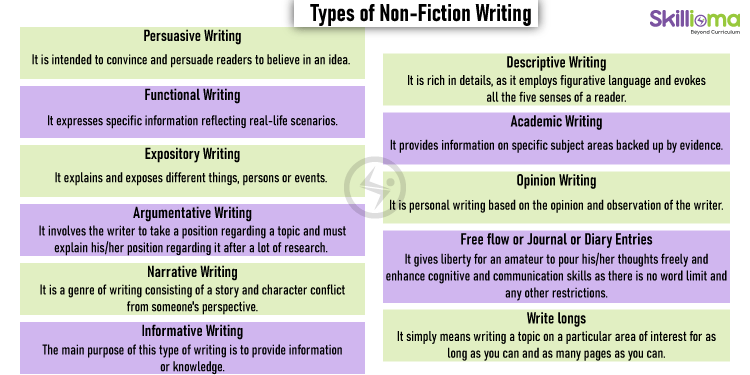
There are different types of non-fiction writing. Let’s explore the most prominent ones:
Persuasive Writing
Persuasive writing is a type of non-fiction writing intended to convince and persuade readers to believe in an idea. Readers are expected to take some action through persuasion. The writer attempts to influence the readers by using logical arguments. Carefully chosen phrases and words are used in persuasive writing. Use of concrete facts and statistics along with research findings establishes credibility to these writings paving the way for easy persuasion.
Examples: Editorials, criticisms, reviews, brochures and advertisements are all examples of persuasive writings.
Functional Writing
Functional writing expresses specific information reflecting real-life scenarios. Complex subjects are made more understandable through functional writing. This type of writing gives advice, invites people to something, tells what happened in some situation and also explains how to do something.
Examples: Notices, as well as informal letters, are examples of functional writing.
Expository Writing
Expository writing seeks out to explain and expose different things, persons or events. This kind of writing is used in schools and other academic platforms. Expository writing provides as much information possible regarding a topic. After reading expository writing, the reader must feel as if he/she has learned something.
Examples: It includes essays, textbooks, instruction manuals, technical writing, magazines and newspaper articles.
Argumentative Writing
It is a genre of writing which involves a lot of research work. The writer must investigate and research on different topics. The writer has to take a position regarding a topic and must explain his/her position regarding the topic after a lot of research work. Credible sources must support his/her arguments. These are usually extensive research works collecting data, surveys and generating results from the collected observations.
Examples: Thesis papers are examples of argumentative writing.
Narrative Writing
A genre of writing which has a story and character conflict is known as narrative writing. Character, plot, setting, theme and conflict are the five elements of narrative writing. This type of writing can be written from different perspectives. The point of view of the narrator can vary according to the demand of narration. Narrative writing can either be a first-person narration, or it can also be a third-person narrative.
Examples: Personal stories, Biography stories, movies, jokes and short films are all examples of narrative writing.
Informative Writing
The purpose behind informative writing is to provide knowledge; the writer focuses on the why or how of a question and provides answers to several questions. Readers are educated through informative writing. Straightforward information is provided for different topics. It does not aim at influencing the reader. The main purpose of informative writing is to provide information to the reader.
Examples: Interviews, articles, as well as brochures and essays, are a few examples of informative writing.
Descriptive Writing
Descriptive writing evokes all the five senses of a reader. This type of writing is rich in details, as it employs figurative language. The reader gets a visual image of the people, objects as well as the places mentioned in writing. Reader experience is enhanced through sensory details, and hence readers find descriptive writing more engaging.
Academic Writing
Academic writing aids reader understanding. It is structured, focused and clear with formal style and tone. This type of writing is backed up by evidence. Academic writings provide information on specific subject areas.
Academic writing is used in the field of academics.
Examples: Research papers.
Opinion Writing
Opinion writing is a common form of evolving non-fiction writing. Opinion writing, as the name suggests, provides an opinion regarding specific events or persons. It is a kind of personal writing based on the opinion and observation of the writer.
Examples: Personal blog writing
Free flow or Journal or Diary entries
Although, officially, this is not well known as a writing style. Over the decades, this type of writing has proven to improve your thinking and written communication. As this is free flow writing, the writer does not have to limit themselves in terms of word count and also not pay particular attention to grammar, sentence structure, flow etc. This gives the liberty for the amateur writer to pour their thoughts freely and thus enhancing their cognitive and communication skills.
Examples: Journal writing, Diary entries or Free flow non-fiction writing.
Write longs
This style of writing is also not officially well known. Many schools in the USA adopt this writing style and assign these tasks to kids at school or college because of the immense help it provides to the development of the child in both cognitive and communication skill areas. Write longs simply mean to write on a particular area of interest or topic for as long as you can and as many pages as you can. This helps in improving your diligence, patience and commitment. In the USA, there is something called ‘behavioural grade’ and ‘write longs’ are an easy assessment to understand a child’s perspective and behaviour.
Examples: Any article or opinion writing but writing for a long time.
Conclusion
Non-fiction writing has evolved over the ages. It has evolved and moulded itself according to the needs of the digital age. In this article, we have traced different types of non-fiction writings ranging from persuasive writing to opinion writing.
Learning to write different types of writing is an integral part of developing communication skills. People often ignore the need to learn writing, assuming it would not help with speaking skills. But, in reality, reading, writing, listening, vocabulary and speaking are closely connected to improve your communication skills. And your cognitive, critical thinking skills will improve with writing different types of pieces.
At workplaces, you need to write professional emails, and this practice of writing will help improve your job functions very well.
Citations :
Power Words :
- Subjective
- Persuade
- Perspective
- Credibility
- Genre
- Diligence
- Narrator
- Enhance
- Integral
- Amateur
- Cognitive
Critical thinking challenge question :
Write a persuasive writing piece on why you need to learn a skill to grow in your career.
Watch this video for further learning :
Different types of non-fiction writing
Are you ready to take the quiz?
Hashtags :
- #GPSforLifeAndCareer
- #ConsciousIntelligence
- #Kidswiki
- #MindInTheMaking
- #RelevanceInEducation
- #MeaningfulLearning
- #RealWorldSkills
- #SafeContent
- #360DegreeDevelopment
- #Skillioma
- #BeyondCurriculum
- #SkillsBeyondSchool